Sarah, Anthony and Sheila have just returned home after spending 5 weeks volunteering at Quishuar in the Cordillera Blanca. Here are Sarah’s memories of their time. There are more photos on our Facebook page.
PERU with LED 2015
We have just returned from a brilliant stay in the village of Quishuar. I, as a retired GP, was working at the health post with Tula, the nurse, while husband Anthony and friend Sheila constructed polytunnels, worked on the water supply, and did an official plan of the secondary school. The villagers knew they needed this and would have had to pay for it, had not this engineer ‘dropped out of the sky’ (to quote the village president in a speech!).
After a night in Lima, we took the 8 hour comfortable bus to Huaraz and were met by Val. We had 3 days acclimatising in Huaraz, at over 3000 metres. In this time we visited a wonderful stone ‘forest’, Pampas Chico in the Cordillera Negra, up to 4350 metres, where there were ancient rock carvings and paintings, and amazing views of the Cordilleras Blanca and Huayhuash. In Huaraz we went shopping with Val for lengths of plastic to make polytunnels, and various necessities for Quishuar, and enjoyed coffees and lunch in the Cafe Andino. We were joined by 4 Canadians, Brian, Mia, Jim and Donna, who had brought out 60 small individual solar powered lights, supplied by the charity LED (Light, Education, Development) to be distributed to individual homes in the villages.
We then had a wonderful night in a teepee at the Lazy Dog Inn at Cachipampa, higher in the mountains, to help further with the acclimatisation process and study their amazingly productive greenhouses.
 The following day we were off on our ‘trip proper’, heading for Quishuar. This involves a 6 to 7 hour (private) bus journey, first to the town of Yungay, which had been totally devastated by the 1970 earthquake, and relocated further along the valley. We stopped there for some shopping, and then headed over the amazing Llanganuco pass, at 4767 metres, a convoluted switchback route on unmade roads. The views were amazing, and we stopped at the top for photos and lunch. There was some cloud about but we were still able to see the wonderful snowy Huascaran peaks, the highest in Peru. The avalanche risk up there is very high these days, meaning many climbers avoid them – 50 people were killed over a 4 year period recently.
On the way down the pass, Val and Juan ran, on the trekkers’ route, managing to keep pace with the bus as meandered down the switchbacks. We then went on to the village of Yanama, where we turned off down a side road, heading for our night’s camp at Chingli (3477 metres).
The following morning we headed on foot up and over the Yangahirca pass, climbing steeply at first. We were all very much aware of the altitude, puffing considerably more than we felt we should have been! The beautiful mountain flowers were in full bloom. The sight of two black-headed gulls was apparently not a good sign. They only come this far inland when bad weather is forecast… The rest and picnic on top, at 4450 metres, was very welcome. Again, clouds meant we were unable to see most of the magnificent snowy peaks which surrounded us. Val gave a good description though! We were able to see the ruins of an Inca fort to the right of the pass, and over to another Inca site on a distant hill.
 As we headed down into the valley where Quishuar nestles at 3740 metres, we were joined by a delightful 9 year old girl, Marietta, who had clearly been on the lookout for Val. We all received the first of many hugs, which we were to experience from the delightful local children. Hand in hand, she and Val danced on downwards into the village.
As it was a festival weekend, many of the villagers were away partying, and we were not treated to a ‘welcome dance’ (which upset some of the local ladies, who had not been told we were coming). However, Tula the nurse was there to greet us, and we were given welcome tea and soup. The Borros (donkeys) were released from their loads, and led by Freddie and Augustine down to the river to drink.
The health post sits in a lovely setting, with stupendous views up the valley to snowy peaks in the distance. There was enough grassy space in front for the Canadians to put their tents, and the rather dilapidated polytunnel stood to one side. This had previously been full of wonderful vegetables, but had fallen into disrepair, along with the one down below at the primary school – jobs waiting for Ant and Sheila. The bedroom for the 3 of us doubled as the examination room, so had to be tidied in the daytime!
We all had 3 days together in Quishuar, before Val and the Canadians departed on their main trek. The others used this time to day treks (and a day off!), while Val and I spent time getting to grips with the contents of the health post and doing home visits so that I could meet, with Val, the older and frailer members of the community, all of whom had known Val for many years. I knew that this would be an invaluable time, largely because of Val’s fluent Spanish! The villagers mainly speak Quechua, the original Andean native tongue. We trekked about between houses, were given my first meal of guinea pig in a wonderful farmstead where a turkey insisted on repeatedly displaying himself to us, and spoke (with Melke’s help) to the villagers of Inhenuo, to reassure them that they were still welcome at the Quishuar health post. We visited a 90 year old man, Gregorio, in his bed at home, well cared for by his family, who was in a lot of pain and appeared terminally ill. We weren’t sure what was wrong with him, but gave him assorted medication in hope, attempting to make him comfortable.
On the Monday Tula returned early from a weekend with her family, and with Val the three of us had a busy day in clinic. I have no doubt that people had come to see their beloved Val (rather than the doctor from England…). The day went well, and we all enjoyed it, and learnt from each other. Tula is fluent in Quechua, and Val in Spanish and English, so we all got by. Some of the patients had muscular problems I felt would respond to acupuncture, and I had some needles with me….. I soon realised I had not brought enough needles, especially when their treatments were successful, and they sent their friends…
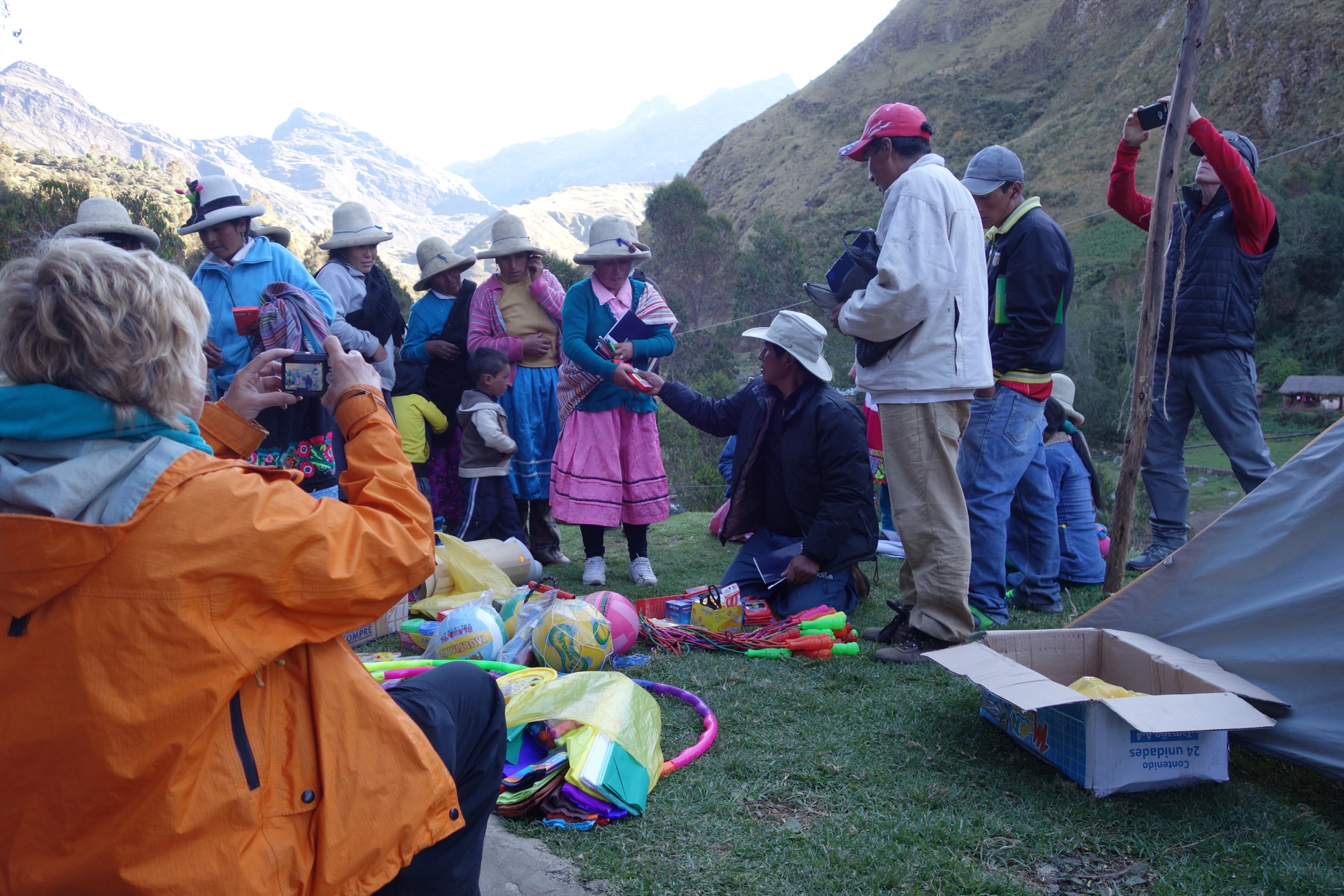
In the afternoon there was the presentation of ‘goodies’ to primary schoolchildren. Many came with their mothers, and some fathers, to the health post and were presented with individual packages of exercise book, pencil, pen, crayon, rubber etc. there were also some general presents for the school – footballs, hula hoops, posters etc. Previously these would have been given at the school, known as the Val Pitkethly school, and about to have it’s 10th anniversary. But over the last year many things have disappeared. Val knows that now mothers know what has been given, things will not disappear in future! The recent unsatisfactory head teacher has thankfully now been removed, at the request of local parents.
That evening we visited a lady who had fallen on a rock 2 weeks before. She had not sought help straight away for the big gash in her lower leg, and now had a badly infected gaping wound, was in a lot of pain and could barely walk. Val cleaned the wound carefully, and we gave her antibiotics; it will be a long healing process.
 The next day, we were lucky enough to join the others for the first day of their trek, over the pass. Val and I visited the lady with the leg wound first, and had to walk hard to catch them up. Val is very fast. I puff a lot! It was another great walk. This time, coming down into the village of Jancopampa, there was a real welcome party! People had come from miles around, not least because they were to be receiving many of the solar lights which the Canadians had brought. Carmen, the previous nurse at Quishuar, now works there; it was lovely to meet her, and her 5 year old adopted disabled son (his mother died in childbirth) Maximo, who has learnt to walk, with help, since Val last saw him. He is a bundle of fun, and it was great to see the other village children taking his hands so he could get about.
We were given a celebratory meal of guinea pig (with, as before, many potatoes – traditional Peruvian fare – and a spicy tomato sauce). After this was the presentation of lights, given out to individuals by us, rather like a school prize giving. This was all very organised, thanks to Carmen. (Some people try and ‘jump the system’ by trying to get a second lot for their household! Makes us very aware of how greedy we are with energy consumption at home.) Then the dancing started, accompanied by a beautiful handmade Peruvian harp, pipes and a violin. The dances were quite long! The ladies looked lovely in their beautiful skirts and hats. The skirts often match in people from one family or village, as do hats, and the bands around the wonderful Peruvian hats have distinctive meanings. For example, a black band may signify a widow, a white one a married lady, and a pink one an ‘available’ lady. Interestingly there are many fewer cataracts and other eye problems in rural Peru, where hats are worn, than in Nepal, where they are not.
After the dancing, many of the people had quite a walk back to their homes. The sun had disappeared, which meant that temperatures would rapidly drop below freezing. Val, Carmen and I disappeared to discuss some local medical issues. Actually, this ended up involving the consumption of very tasty local hooch, and more dancing!
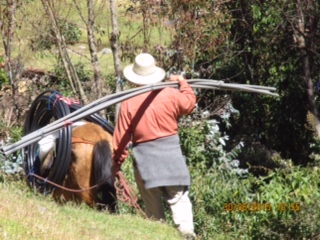 The next morning the others left after breakfast to carry on with their trek. Our day, returning to Quishuar, was easier than yesterday’s because the ascent is less from this side. So we watched while the burros (donkeys) were rounded up, escaped several times, and loaded. They carry big loads of course, carefully tied together with ropes and balanced. One of them carries 2 gas cylinders for cooking in camp, on a special frame. For the 4 of us returning to Quishuar, we had a horse to carry our belongings. Horses are used much more in this area. They can withstand the extremely cold nights better than donkeys, who tend to have short lifetimes if kept here permanently.
Juan led us back to Quishuar, and looked after us wonderfully for the rest of our time there. He is the 31 year old son in law of Melke, himself the son of the original guide whom Val worked with when she started in Peru. Juan speaks pretty good English, and as well as doing the cooking, acts as interpreter for me in all consultations or teaching of Tula, and for Ant and Sheila in their discussions with various villagers over water supply and greenhouse construction. Needless to say, Juan was required in several places at once most of the time, and dealt with this very commendably!
Tula had prepared some delicious soup for our return, and we celebrated (!) with a cold shower. There is supposed to be hot water in the health post – it does have power – but the ‘water heater’ was most definitely caput, so any attempt at a shower was decidedly icy, and needed to be taken while the sun was up… (For anyone reading this and going to Quishuar in the near future, this problem is being rectified!)
The next weekend we were off on another overnight camp, thanks to Juan, who loves adventures in the mountain, and didn’t mind carrying 2 tents… We found a most beautiful sheltered spot, quite high up, with wonderful views of the glacier, and a big flat stone which made a great table for playing rummikub! There was a hard frost overnight, and in the morning we stood watching the sun creep towards us over the valley. Once it reached us, we were too hot within minutes! Amazing to think the horses survive these very cold nights on a nightly basis.
That afternoon, back in Quishuar, we had an appointment with some of the village ladies, who had asked for an informal talk on health issues, on a Sunday afternoon when they have ‘time off’ from their work with the animals and in the fields. They wanted to know about healthy diets and infections caught from their husbands(….); we covered contraception and much else too. I’m not entirely sure what ‘I’ said, because for every short sentence I spoke, Juan’s translation went on for several minutes, and was clearly quite graphic and numerous (he likes being theatrical I think). Whatever they learnt, they appeared to enjoy it, and we’re certainly appreciative.
On the following Tuesday, Juan’s theatrical leanings were tested still further, when with Tula we did a ‘sex education’ session at the secondary school. Juan had to do this last year too, and does get a bit nervous… Last year he had a cucumber for demonstrating condom usage; this year was a carefully handcrafted carrot. Teenage pregnancies are far too common, and parents, teachers and pupils are all keen for more education. The health post can provide various forms of contraception, which I described. But I had forgotten that this is, naturally, a predominantly catholic school, and one teacher was less than happy, and intervened to describe at length the ‘rhythm’ method. I was told later that everyone (apart from this teacher) had much appreciated it!
While on the subject, we noticed that families tend to be very large – not uncommonly 8 to 12 children in a family. This tends to happen in developing countries – historically there would have been a high infant mortality rate. But we were told that, in the Andes, men prefer to keep their wives pregnant so they are more likely to stay faithful!! A lot of women probably use contraception, unknown to their husbands..
Other days presented more convention general medical practice. With Tula translating from Queshua into Spanish, and then Juan into English, each consultation took a little longer… As with medicine in Nepal, general practice is not so different from England – coughs and colds, aches and pains… There is a higher incidence of ‘gastritis’ type problems, a fair bit of alcohol among the men, and to have a low threshold for treating possible worm infections is a good idea. I was impressed that patients had paper records. But these have not been well kept recently, and we’re not in order. Tula and I had a good blitz on this, and before I left it was gratifying to be able to find the right notes easily.
When we didn’t have patients, and when Juan wasn’t cooking lunch (we needed him for translation and for being a ‘dummy’ patient), we would have teaching sessions with Tula. She has had a 3 year nursing training, but is still keen to learn how to be more of a ‘nurse practitioner’, working alone in the health post, having to learn to make diagnoses and prescribe appropriately. As with the remote health posts in Nepal, the health workers do a remarkable job in very isolated conditions.
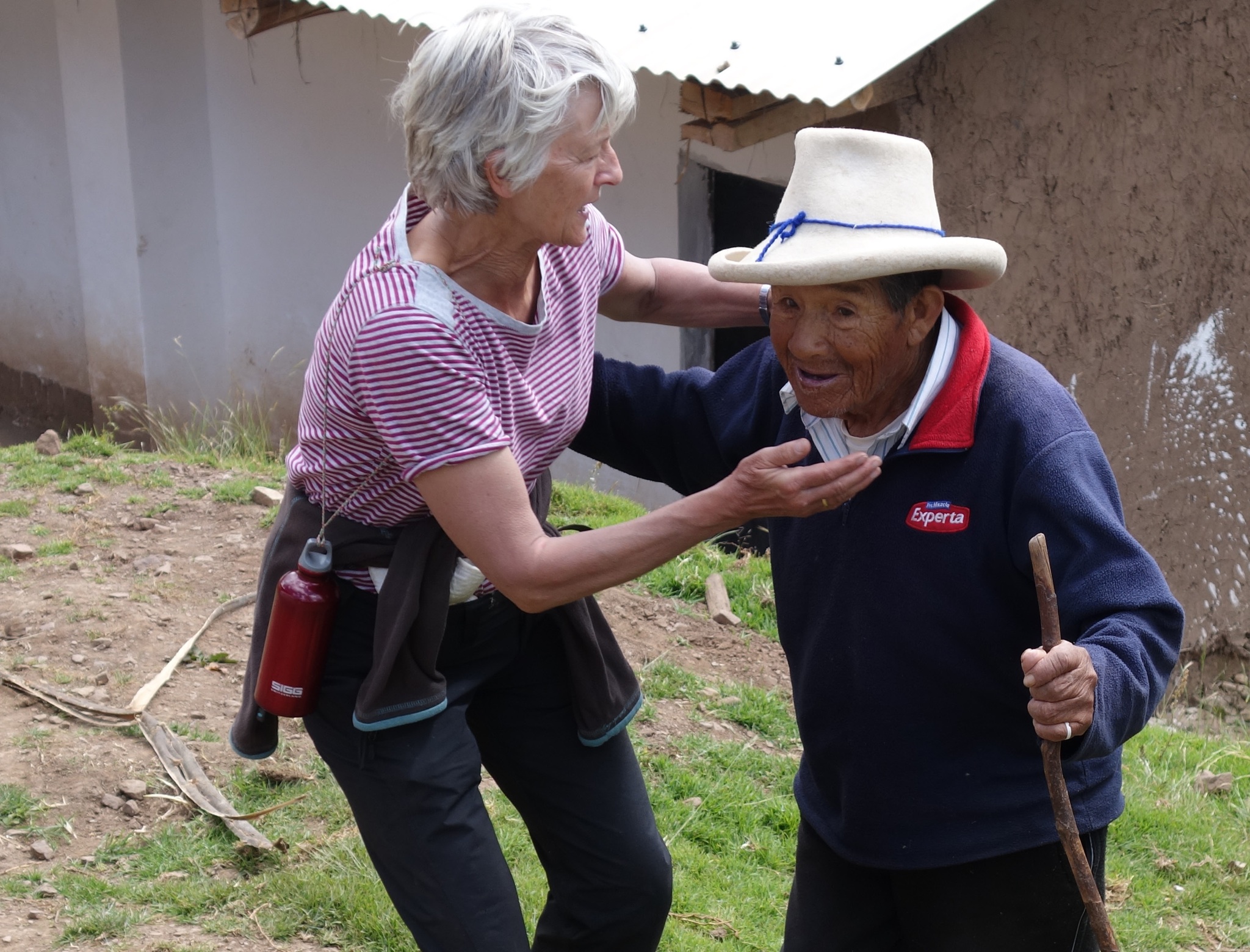 The lady with the infected leg wound made great progress, and was soon stopping to herd her pigs before settling down for her leg dressing. The 90 year old man Gregorio who we had classed as ‘terminal’ when I first visited with Val, was soon back to remarkable health, and walking the uphill mile to the health post to ask for a hearing aid! (They keep some ‘off the peg’ Canadian ones there). He was so delighted to be able to hear again, and they day before we left was admiring the new greenhouse in the secondary school opposite his house!
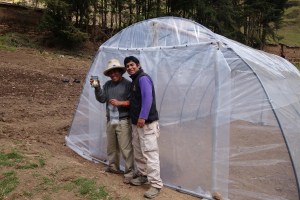 In the meantime, Ant and Sheila, with help from Antonio and Percy constructed a new polytunnel in the grounds of the secondary school down the valley, and rebuilt and recovered the one by the health post. There were insufficient materials to reconstruct the one at the primary school, but we left happy that Antonio and Percy are now expert! Sheila made a compost bin for the health post and left many instructions as to how to fill it! The local people are farmers and know how to make things grow. But the days are short and the nights very cold at this altitude. The women in particular are keen to grow vegetables for their families, and we’re very happy when the greenhouse was working successfully at the school. They were full of thanks when we left.
Ant and Sheila also worked on the water supply, and made a plan of the secondary school, which they needed to obtain a grant.
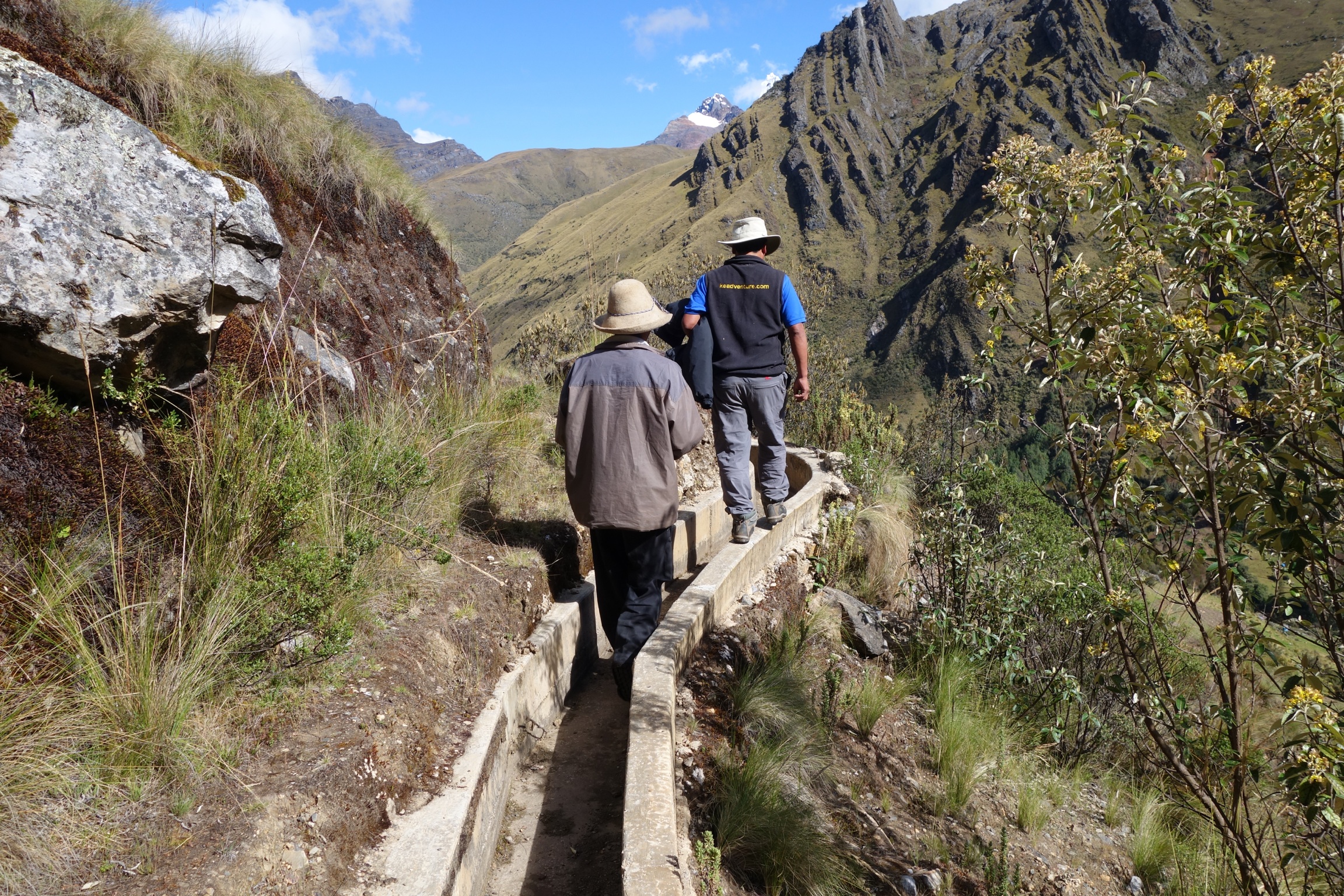


We learnt a lot of things about village life in the Andes. We also learnt just a little of the potential horrors brought by international mining companies, of which there are plenty in this part of the world. Gold is very much a mixed – if any – blessing. The companies which have arrived so far to mine it do not bring anything, despite promises, to the local economy. They bring in workers from other countries, who live in enclosed compounds, with their own shops and schools. The infrastructure required to build and access a mine destroys huge areas of valleys and mountainsides. It pollutes river so that animals die, and crops do not grow. Villagers may have received a pittance each, but have no idea until it is too late that they will have to relocate entirely, and find another valley (or probably more likely, a town) to live in. Most worryingly, the mines pay large sums to selected individuals within a village, to work on the villagers and persuade them to hand the land over. This has been happening in Quishuar (probably the above mentioned headmaster was one of the selected individuals), which explained some of the discomfort we experienced, especially when we first arrived. By the time we left, we were assured all the ‘baddies’ had apologised, and the villagers were saying no to the mine. Time will tell… It is heartbreaking to think this beautiful valley and community could potentially disappear.
Juan took us safely back over the pass at the end of our stay. The lovely Augustine and driver were there with a pickup to take us on the final stage, over the switchback pass. For their journey Augustine rode in the back of the truck, which must have been unimaginably uncomfortable, but he kept smiling… We had a lovely last 3 nights at the Colombo Hotel in Huaraz, looked after by Lucio. On one day we were real tourists, and were taken on a 3 hour beautiful drive to Chavin, a 3000 year old remarkable archaeological site. Quite equivalent in its history to Machu Pichu, but with no other tourists. We wandered the underground labyrinths unhindered.
Thank you to Val, to Juan and to all the lovely Peruvian people who helped us in our stay.
Sarah, Anthony and Sheila
 Light Education Development